Chemical Peels
Chemical peeling is among the most common cosmetic procedures and has been used for many years. It is a method of targeted cutaneous ablation induced by specific caustic agents that allows chemoablation thickness to be rapid, predictable, and uniform to the desired cutaneous depth, ultimately improving the clinical appearance of the skin. The main objective of a chemical peel is to remove a uniform thickness of damaged skin that allows normal wound healing and skin rejuvenation to occur, while at the same time reduces the complications such as scarring and unwanted pigment changes.
Chemical Peels classification
Based on the depth of penetration, chemical peels are categorized.
Superficial (epidermis, papillary dermis)
For mild skin disorders such as dyschromia, acne, postinflammatory hyperpigmentation, melasma, and actinic keratosis, superficial peels are most commonly used.
Medium (papillary to the upper reticular dermis)
In solar keratoses or lentigines, pigment disorders, and superficial scars, medium-depth peels are used.
Deep peels (mid-reticular dermis)
For the treatment of photo-aging, deep scars or wrinkles, and precancerous skin lesions, deep chemical peels are used.
Chemical peels for skin
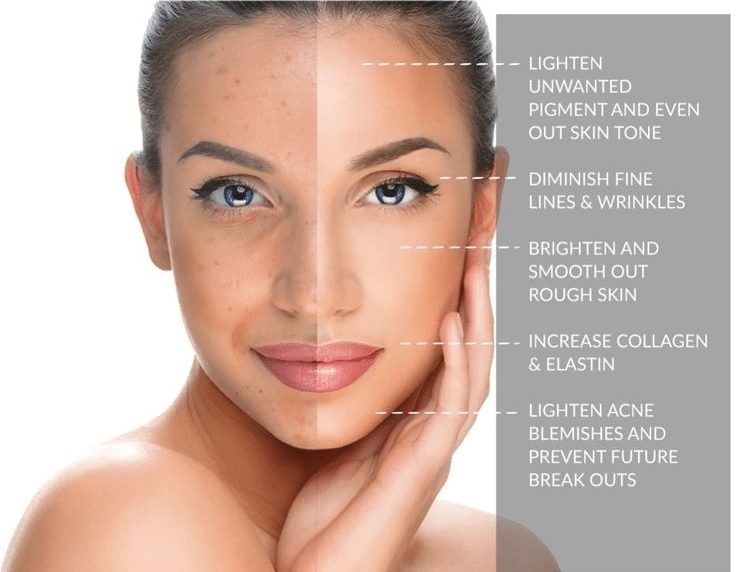
Chemical peels may enhance the look of the skin. The skin becomes smoother and less wrinkled than the old skin after the treatment. Chemical peels reduce fine lines under the eyes and around the mouth, decrease age spots, freckles, and dark patches (melasma) which are formed due to pregnancy or taking birth control pills and improve the look, glow and feel of the skin.
Chemical peels for the skin dealing with acne
For the treatment of acne, superficial and medium depth peels are important as it is a relatively low cost and secure procedure. They target most of the factors involved in acne that are pathophysiological. With subsequent exfoliation, chemical peels break down corneosomes and induce keratolysis. Sebum production and pore size are also reduced, and they have anti-inflammatory and anti-bacterial properties. Chemical peels increase the penetration and absorption of various topical therapies by decreasing the stratum corneum’s barrier effect. All these characteristics and the fact that surface peels are safe and can be used in combination with other medications for acne make them very popular. In acne, the most frequently used superficial and medium-depth peeling agents are SA, SA, α-hydroxyl acids (GA, LA, etc.), JS, and TCA.
Chemical Peels for the skin dealing with Melasma
Melasma is a widespread chronic acquired refractory hyperpigmentation of the skin that has a significant effect on the quality of life and is difficult to treat. Chemical peels are a well-known treatment method and form the second line of melasma management and may help improve the epidermal component of melasma. The dermal component is managed by the peel’s ability to induce stagnant melanin phagocytosis. Research shows that melasma clearance is better and faster when chemical peels are combined with topical therapy. Topically, sequencing peels with a triple combination have shown better efficacy when measured by spectrometry in moderate to severe melasma. Melasma priming is essential for at least 4 weeks before the procedure. Not only does it ensure uniform reagent penetration, but it also reduces the risk of complications. Therefore, it is vital to select the correct and specific priming agent. In epidermal melasma of < 1-year duration, peels yield a good result. To enhance epidermal pigmentation, peels are helpful for these Peels are need to be paired with topical treatment and maintenance therapies.

Chemical peeling agents
Lactic acid
Lactic acid is another alpha-hydroxy acid used either alone or in combination with other peels as adjuvant therapy for acne. By decreasing corneocyte adhesion and removal of dead skin cells, LA decreases the thickness of the stratum corneum and leads to the formation of a new stratum corneum.
Salicylic acid
SA is a 2-hydroxybenzoic acid that is used for superficial peeling. It promotes epidermal cell shedding and can penetrate comedones and pores to prevent clogging and neutralize bacteria because of its lipophilic properties. The desquamation of the upper lipophilic layers of the stratum corneum is facilitated. In acne patients, these chemical properties explain its popularity and success.
Trichloroacetic acid
TCA is a crystalline inorganic compound that depends on the concentration used, is used as a superficial, medium-depth or deep peeling agent. TCA causes epidermal and dermal protein denaturation, dermal collagen destruction, and epidermal cell coagulative necrosis. It self-neutralizes this peel and has very low systemic absorption.
Mandelic acid
Mandelic acid is an alpha-hydroxy aromatic acid that is widely used to treat mild to moderate acne. Mandelic acid induces epidermis exfoliation by decreasing corneocyte adhesion. It is a large molecule that slowly enters the skin and has antibacterial properties.
Glycolic acid
GA belongs to the alpha-hydroxy acid group and is used in acne treatment as a superficial or medium depth peel. GA is an exfoliative agent that causes epidermolysis by reducing corneocyte adhesion and keratinocyte plugging at the granulosum stratum by desquamating the skin. Provides benefits for both inflammatory and non-inflammatory acne.
Jessner’s solution
JS is a superficial peeling agent that is a combination of 14 percent SA, 14 percent resorcinol, and 14 percent LA in 95 percent ethanol used as adjuvant therapy for acne. JS peel is commonly used to increase its penetration with other peels.
Phenol
Phenol is an aromatic alcohol that has been used as a deep chemical peel for years in the dermatology field. It causes epidermolysis, epidermal keratin coagulation, and dermal elastosis. This leads to activation of dermal fibroblasts and new collagen synthesis
Kojic acid
KA is a copper chelating agent produced by certain fungi, also known as 5-hydroxyl-2-(hydroxymethyl)-4-pyrone. Its skin lightening properties stem from its capacity to inhibit the enzyme tyrosinase. KA can be used in patients with active acne to prevent and treat postinflammatory hyperpigmentation before and after peeling.
Post-treatment Consideration
Optimum postprocedure care is essential for reducing the risk of complications and ensuring the rapid recovery of normal skin. This is consistent with the condition that is being treated.
- Ice compress: post-procedure immediately to decrease discomfort.
- Emollients: in the event of excessive desquamation.
- Maintenance: resumption of creams for lightning and peels for maintenance.
- Broad-spectrum sunscreen: essential for erythema and especially for darker skin types.
Dr Refresh Med Spa in West Hollywood, Los Angeles we offer chemical peels for all skin types. Book yours now or read more here.
Reference
David E Castillo and Jonette E Keri: Chemical peels in the treatment of acne: patient selection and perspectives. Published online 2018 Jul 16. doi: 10.2147/CCID.S137788
Rashmi Sarkar, Shehnaz Arsiwala, Neha Dubey, Chemical Peels in Melasma: A Review with Consensus Recommendations by Indian Pigmentary Expert group2017 Nov-Dec; 62(6): 578-584. doi: 10.4103/ijd.IJD_490_17
Rabecca Small: A Practical guide to chemical peels, Microdermabrasion and tropical products.
| Teo Soleymani, Julien Lanoue : A Practical Approach to Chemical Peels. A Review of Fundamentals and Step-by-step Algorithmic Protocol for Treatment.2018 Aug; 11(8): 21-28. |
At Dr Refresh Med Spa, our chemical peel West Hollywood treatments deliver exceptional results backed by years of expertise. Patients seeking chemical peel Los Angeles services choose us for our personalized approach, advanced technology, and commitment to natural-looking outcomes. Located in the heart of West Hollywood at 1106 N La Cienega Blvd, our clinic serves clients throughout Los Angeles seeking premium aesthetic treatments.
Located at 1106 N La Cienega Blvd Suite 206, West Hollywood, CA 90069, Dr Refresh Med Spa offers a variety of advanced skincare and wellness treatments to enhance your beauty and well-being. From transformative Morpheus8 and rejuvenating laser facials to wrinkle relaxers West Hollywood residents trust, our team ensures you receive personalized care. Whether you’re considering fillers or exploring the benefits of Emsculpt Neo, our med spa West Hollywood location is dedicated to helping you achieve your aesthetic goals. Experience holistic wellness with our IV therapy West Hollywood services. For appointments or more information, visit drrefresh.com or call us at (323) 530-2879.